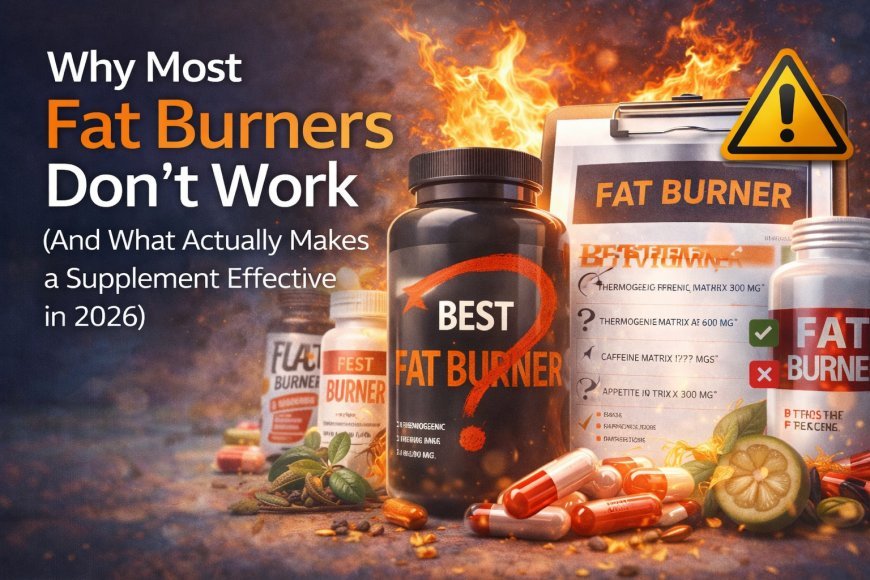
Why Most Fat Burners Don’t Work
The global fat-burner market is worth billions. Every year, new supplements promise rapid weight loss, boosted metabolism, and effortless fat reduction.
Why Do Most Fat Burners Fail?
Most fat burners fail because they rely heavily on stimulants, underdosed ingredients, and unrealistic marketing promises instead of supporting sustainable metabolism, appetite control, and long-term adherence. Effective fat-loss supplements typically work best when combined with calorie control, exercise, and consistent lifestyle habits.
And What Actually Makes a Supplement Effective
Most fat burners fail for a simple reason: the formula sounds better than it performs.
The global fat-burner market is worth billions. Every year, new supplements promise rapid weight loss, boosted metabolism, and effortless fat reduction.
Yet millions of people try fat burners and see little to no meaningful result.
So what is really happening?
Are fat burners a scam?
Or are most people simply using the wrong products?
The truth is less exciting than the marketing:
Most fat burners fail not because all fat-loss supplements are fake, but because many formulas are weak, underdosed, overly stimulant-dependent, or built around label appeal instead of metabolic science.
Before spending money on another bottle, it helps to understand how fat loss actually works.
Want the deeper science first?
Read our full guide on what fat loss supplements actually do in the real world before comparing products.
1. How Fat Loss Really Happens
Fat loss is not magic. It is not detox tea. It is not one secret ingredient.
It is a metabolic process involving:
- thermogenesis
- lipolysis
- insulin sensitivity
- appetite regulation
- energy balance
If a supplement does not influence at least one of these mechanisms in a meaningful way, it is unlikely to produce noticeable real-world results.
Most do not.
For a broader evidence-based foundation, start with our science-based weight loss guide.
| Mechanism | What It Does | Why It Matters |
|---|---|---|
| Thermogenesis | Raises energy expenditure slightly | Can support a deficit over time |
| Lipolysis | Mobilizes stored fat | Helps make fat available for oxidation |
| Insulin sensitivity | Improves nutrient handling | Supports better metabolic flexibility |
| Appetite regulation | Helps reduce intake pressure | Makes adherence easier |
| Energy balance | Determines long-term direction of body mass | No supplement overrides this |
2. The 5 Biggest Reasons Most Fat Burners Fail
1. Underdosed Ingredients
This is the most common issue.
Many supplements list trendy ingredients such as:
- garcinia cambogia
- green tea extract
- L-carnitine
- chromium
But when you examine the dosage, it is often far below clinically useful levels.
Manufacturers frequently rely on label familiarity rather than metabolic effectiveness.
Result: little or no measurable impact.
2. Proprietary Blends Hide Weak Formulas
When a label says something like “Proprietary Fat Burning Matrix – 1200 mg,” that is often a warning sign.
You cannot tell:
- how much caffeine is actually included
- whether thermogenic compounds are properly dosed
- whether appetite-support ingredients are present in meaningful amounts
Transparency matters because effectiveness depends on actual amounts, not branding language.
3. They Focus Only on Stimulants
Many fat burners are basically caffeine products wearing a more expensive costume.
Yes, caffeine can increase thermogenesis modestly.
But stimulant-only products often create:
- energy crashes
- tolerance build-up
- little long-term improvement in metabolic flexibility
Effective fat loss support requires more than temporary stimulation.
4. They Ignore Appetite Control
Fat loss is not only about burning calories.
It is also about controlling intake.
Supplements that ignore:
- satiety support
- hunger regulation
- blood sugar stability
are incomplete tools.
5. They Ignore Metabolic Flexibility
Your body needs to transition efficiently between:
- burning glucose
- burning stored fat
If insulin sensitivity is poor or metabolic flexibility is weak, fat oxidation becomes less efficient.
Most fat burners do not address this at all.
| Common Problem | What It Looks Like | Likely Outcome |
|---|---|---|
| Underdosing | Clinically trendy ingredients, tiny amounts | Minimal metabolic effect |
| Proprietary blends | Hidden ingredient amounts | Poor transparency and weak trust |
| Stimulant-only design | Mostly caffeine and buzz | Short-term energy, weak fat-loss support |
| No appetite support | Ignores intake control | Harder adherence |
| No metabolic support | No focus on insulin or flexibility | Incomplete formula logic |
3. What Actually Makes a Fat Burner Effective?
Now the focus shifts from criticism to construction.
An effective fat-loss supplement should ideally include:
- clinically studied thermogenic ingredients
- appetite-modulation support
- metabolic support nutrients
- transparent dosing
- a safety-conscious formulation
Very few formulas meet all five standards at once.
If you want a bigger breakdown of what actually works and what does not, read The Science of Fat Loss Supplements.
| Effective Formula Feature | Why It Matters |
|---|---|
| Transparent dosing | Lets you evaluate whether ingredients are meaningfully dosed |
| Thermogenic support | Can slightly increase calorie expenditure |
| Appetite control | Helps adherence during a deficit |
| Metabolic support | May improve how the body handles energy |
| Safety-conscious design | Reduces the chance of harsh side effects or poor tolerance |
Want a real product example?
If you want to see how these standards apply in practice, read the full CitrusBurn Review 2026.
Why Stimulant Tolerance Reduces Fat Burner Effectiveness
Many stimulant-based fat burners lose effectiveness over time because the body gradually adapts to repeated caffeine exposure. This tolerance effect may reduce the perceived energy boost and weaken long-term adherence for some users.
This is one reason many experienced users look beyond heavy stimulant formulas and focus more on appetite regulation, metabolic flexibility, and sustainable fat-loss support instead of short-term stimulation alone.
4. The Psychology Behind Fat Burner Failure
Another reason many products disappoint is expectation mismatch.
People often expect supplements to replace discipline, structure, and consistency.
No fat burner can override:
- chronic overeating
- poor sleep
- sedentary behavior
But the right supplement can support:
- a calorie deficit
- training output
- metabolic consistency
The key difference is synergy. Supplements work best when they amplify a good system instead of trying to rescue a bad one.
5. Are Natural Fat Burners Better?
Sometimes, yes.
Natural ingredients such as:
- green tea catechins
- capsaicin
- fiber-based satiety ingredients
- citrus bioflavonoids
can be useful when they are properly selected and properly dosed.
The problem is that many “natural” formulas are timid, underpowered, or incomplete.
Natural does not automatically mean effective.
It only means the source sounds cleaner on the label.
A balanced example of this category is CitrusBurn, which is positioned around thermogenesis, appetite support, and broader metabolic design rather than pure stimulant overload.
6. Warning Signs Before You Buy Any Fat Burner
Before purchasing any product in this category, ask:
- Are ingredient dosages clearly disclosed?
- Are there credible scientific references behind the ingredients?
- Does the formula do more than just deliver stimulation?
- Is there appetite-control support?
- Is the company transparent about the formula?
If the answer is no to most of these questions, reconsider.
For a coffee-based metabolism-support example in a different format, you can also compare the full Java Burn review. :contentReference[oaicite:2]{index=2}
7. Why Informed Consumers Win
The supplement market is more competitive than ever, which is good news for buyers who know how to read labels.
Consumers who:
- read labels carefully
- compare formulas directly
- understand basic metabolic science
tend to choose better products and avoid expensive disappointment.
If you are specifically researching a formula built around thermogenesis, appetite control, and metabolic support, read our full CitrusBurn Review 2026. :contentReference[oaicite:3]{index=3}
8. Realistic Expectations: How Much Can a Fat Burner Help?
Let’s be realistic.
No supplement will cause:
- 10 kg of fat loss in two weeks
- fat melting while you sleep
- spot-reduction miracles
But a better-designed product may help by:
- slightly increasing daily calorie expenditure
- improving appetite control
- supporting energy during a deficit
- contributing to better fat-loss adherence over time
Think in terms of percentage improvement, not transformation.
Even a modest improvement can matter over months, especially when combined with proper nutrition and training.
| Expectation | Realistic or Unrealistic? | Why |
|---|---|---|
| Rapid dramatic fat loss without diet control | Unrealistic | Supplements do not override energy balance |
| Small support for calorie expenditure | Realistic | Some thermogenic ingredients can help modestly |
| Better appetite control | Realistic | Useful formulas may support adherence |
| Complete replacement for structured habits | Unrealistic | Behavior and diet still dominate outcomes |
9. Who Should and Shouldn’t Use Fat Burners?
Better Candidates
- people already in a calorie deficit
- those dealing with a genuine fat-loss plateau
- people struggling with appetite control
Less Suitable Candidates
- pregnant or nursing individuals
- people highly sensitive to stimulants
- anyone expecting a miracle solution
They also should not be the first solution for someone who has not yet fixed calories, sleep, training, and daily activity.
10. The Bigger Picture: Supplements Are Tools, Not Solutions
Fat burners work best as tools inside a larger system that includes:
- structured nutrition
- progressive training
- adequate sleep
- stress management
If you treat them like tools, they may support results.
If you treat them like shortcuts, they usually disappoint.
For a stronger foundation, pair this topic with your broader weight-loss education pages and only then move into product reviews.
11. Final Thoughts: Why Most Fat Burners Fail
Most fat burners fail because:
- they are underdosed
- they rely on hype
- they overemphasize stimulants
- they ignore appetite and metabolic complexity
The solution is not avoiding supplements entirely.
The solution is choosing more intelligently.
If you want to see a real-world example of a formula built around thermogenesis, appetite support, and metabolic design rather than pure stimulation, explore the full CitrusBurn Review 2026. :contentReference[oaicite:4]{index=4}
```html
Related Supplement Reviews
Before choosing a fat-loss supplement, it can be helpful to compare different formulas, ingredients, and approaches. The following reviews provide detailed breakdowns of some of the most popular metabolism and weight-management supplements available today.
- CitrusBurn Review – Thermogenic and metabolism-support formula focused on fat oxidation and energy expenditure.
- Liv Pure Review – Liver-support and metabolism-support supplement designed around long-term wellness and weight-management support.
- Java Burn Review – Coffee-based metabolism support formula often used as part of daily fat-loss routines.
- Mitolyn Review – Mitochondrial energy and metabolism-support supplement focused on cellular energy production.
- LeanBiome Review – Gut-health and microbiome-support supplement designed to support digestion and sustainable weight management.
```
FAQ
Do most fat burners actually work?
Most do not work well because they are underdosed, overly dependent on stimulants, or designed around marketing rather than clinically meaningful formulation.
What makes a fat burner more effective?
A stronger formula usually includes transparent dosing, meaningful thermogenic support, appetite-control ingredients, metabolic support, and a safety-conscious design.
Are natural fat burners always better?
No. Natural ingredients can help, but only when they are properly selected and properly dosed.
Can a fat burner replace diet and exercise?
No. Supplements may support a good system, but they cannot replace a calorie deficit, training, sleep, and consistency.
Who benefits most from fat burners?
They are most useful for people already following a structured fat-loss plan who want modest additional support with appetite, energy, or expenditure.
Are fat burners safe for everyone?
Some fat burners may cause stimulant-related side effects such as increased heart rate, sleep disruption, or anxiety in sensitive individuals.
Do thermogenic supplements actually work?
Some thermogenic ingredients may slightly increase calorie expenditure, but the effects are usually modest and work best alongside proper nutrition and exercise.
Why do stimulant fat burners stop working over time?
Repeated stimulant exposure may lead to tolerance, reducing the noticeable energy and thermogenic effects over time.
Can caffeine support fat loss?
Caffeine may modestly support thermogenesis and workout energy, but it does not override calorie balance or poor lifestyle habits.
}