
















The Fat Loss Paradox: Why Dieting Stops Working
Struggling to lose fat despite eating less? Discover how metabolic adaptation works and learn science-based strategies for sustainable fat loss.
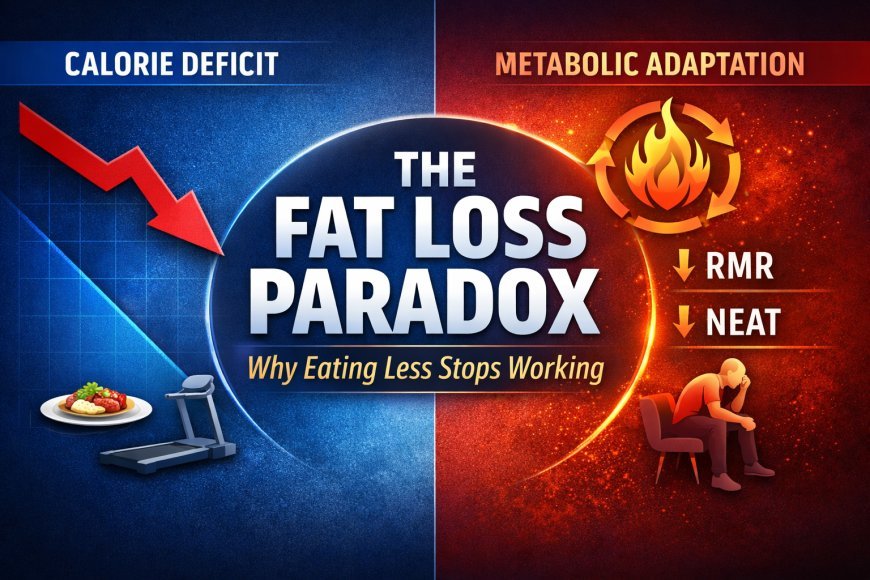
How to Lose Weight Sustainably
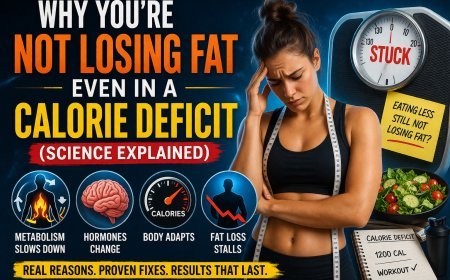
You cut calories.
You increase cardio.
The scale drops.
Then progress slows.
Hunger increases.
Energy drops.
Eventually, weight comes back — sometimes higher than before.
This is not a willpower problem.
It is a physiology management problem.
The fat loss paradox is simple:
The harder you push your body into a deficit, the harder it pushes back.
Understanding that pushback is what separates temporary dieting from sustainable fat loss.
Want a structured fat loss system instead of guessing?
Explore our evidence-based fat loss guides for practical strategies built around real physiology, not shortcuts.
1. Energy Balance: Necessary — But Not Static
Fat loss requires a calorie deficit.
But energy expenditure is not fixed. It includes:
- Resting Metabolic Rate (RMR)
- Thermic Effect of Food (TEF)
- Exercise Activity
- Non-Exercise Activity Thermogenesis (NEAT)
As you lose weight, all four can decrease.
More importantly, your metabolism adapts beyond what weight loss alone would predict.
This is known as adaptive thermogenesis.
After weight loss, metabolic rate can remain suppressed relative to expected levels.
This is why simply “eating less” eventually stops working.
For a deeper breakdown, read metabolic adaptation explained.
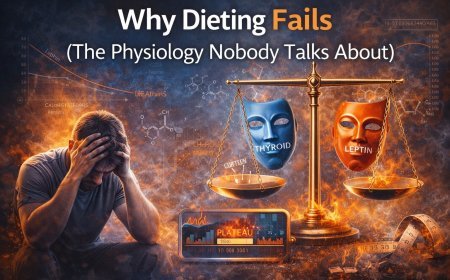
2. Adaptive Thermogenesis: Your Body’s Defense System
Your body interprets rapid fat loss as a threat.
In response, it:
- reduces energy expenditure
- increases hunger
- increases food reward sensitivity
- reduces spontaneous movement
This is not lack of discipline.
This is biology.
This is also why many people hit a fat loss plateau despite consistent effort.
3. Hormonal Changes During Dieting
Fat loss triggers several hormonal shifts:
Leptin
Decreases → hunger increases
Ghrelin
Increases → appetite rises
Thyroid Hormones (T3)
Decrease → metabolic rate drops
Cortisol
Can increase → recovery worsens
Together, these changes reduce adherence and increase the likelihood of rebound weight gain.
For a deeper nutrition framework, read evidence-based fat loss nutrition.
4. NEAT: The Hidden Variable
NEAT includes daily movement such as walking, standing, and fidgeting.
During dieting, NEAT often drops without you noticing.
This alone can eliminate your calorie deficit.
That is why step tracking is one of the most underrated fat loss tools.
Before cutting calories further, reassess your intake using this calorie guide.
5. Muscle Loss and Metabolic Decline
Aggressive dieting without resistance training leads to muscle loss.
This results in:
- lower metabolic rate
- reduced performance
- easier fat regain
To preserve muscle, prioritize:
- high protein intake
- resistance training
- moderate fat loss rate
For a practical strategy, read how to lose fat without losing muscle.
6. Plateaus: What They Actually Mean
Plateaus are not random.
They are caused by:
- metabolic adaptation
- reduced NEAT
- loss of lean mass
- tracking inaccuracies
The solution is not always eating less.
It may be:
- increasing daily movement
- adding resistance training
- introducing a diet break
- recalculating maintenance
7. The Sustainable Fat Loss Model
- 0.5–1% bodyweight loss per week
- high protein intake
- resistance training priority
- 8,000–12,000 steps daily
- planned diet breaks
For the science behind diet breaks, read diet breaks explained.
8. Reverse Dieting and Recovery
After long dieting phases, increasing calories gradually can help restore performance and reduce hunger.
Reverse dieting is not magic — it is simply controlled recovery.
For a full breakdown, read reverse dieting explained.
9. Why Weight Regain Happens
- hormonal changes
- environmental exposure
- loss of structure
- psychological fatigue
Fat loss without a maintenance strategy often leads to rebound.
Maintenance is the real skill.
10. Final Takeaway
Fat loss is not about fighting your body.
It is about working with it.
When you stop escalating restriction and start managing adaptation, fat loss becomes sustainable.
Consistency beats aggression.
Ready to approach fat loss the right way?
Browse our science-based fat loss resources and start building a system you can actually sustain.
Frequently Asked Questions
How long does metabolic adaptation last?
It can last for months, but it usually improves with proper maintenance phases and recovery.
Is a plateau always metabolic adaptation?
No. Tracking errors, reduced movement, and water retention are also common causes.
Should I add more cardio during a plateau?
Only if recovery is preserved. Increasing steps is often a better first approach.
What is a sustainable fat loss rate?
About 0.5–1% of bodyweight per week for most people.
Can metabolism be permanently damaged?
No strong evidence suggests permanent damage from normal dieting. Most effects are adaptive and reversible.
What's Your Reaction?