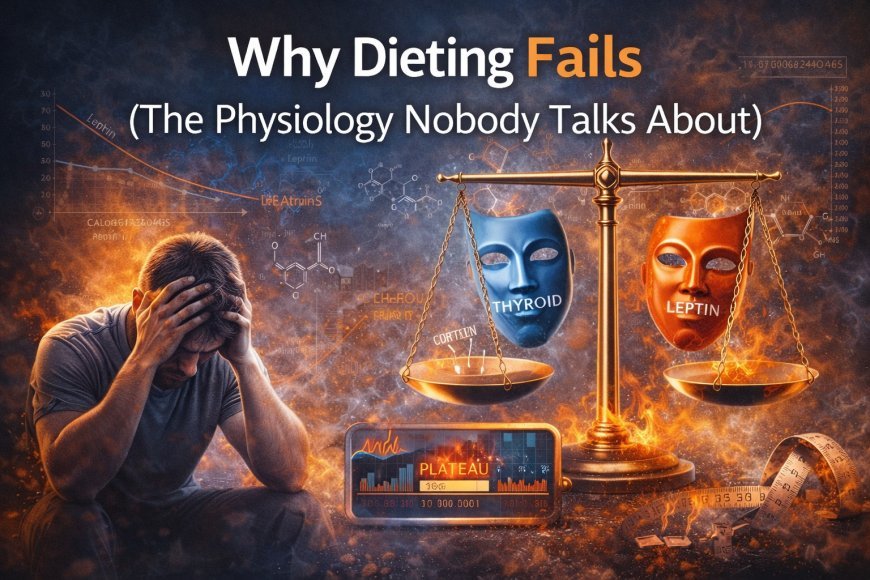
Why Dieting Fails
Most diets fail because of metabolic adaptation, muscle loss, and hormonal shifts. Discover the physiology nobody explains — and what actually works.
Why Do Most Diets Fail Long-Term?
Most diets fail long-term because prolonged calorie restriction triggers metabolic adaptation, increased hunger signaling, reduced energy expenditure, and lean-mass loss. Sustainable fat loss usually requires moderate deficits, resistance training, adequate protein intake, and long-term maintenance planning rather than extreme restriction.
The Physiology Nobody Talks About
Why Most Diets Fail Long-Term
A Comprehensive Evidence-Based Review
Introduction
Long-term dieting failure is often blamed on poor adherence, weak discipline, or lack of willpower.
But evidence from metabolic physiology, endocrinology, and body composition research suggests a more important reality:
the body adapts to energy restriction in ways that make continued fat loss harder and weight regain more likely.
During prolonged dieting, resting metabolic rate can fall, spontaneous movement often declines, hunger signals increase, and lean mass may be lost if training and protein intake are poorly managed.
This article examines the biological mechanisms behind diet failure, including metabolic adaptation, hormonal modulation, muscle loss, appetite neurobiology, and structural flaws in common commercial diet models.
The goal is not to reject energy balance. The goal is to place energy balance inside the dynamic biological system that actually governs dieting outcomes.
Need the short version first?
Start with The Fat Loss Paradox for a practical breakdown of why dieting stops working over time.
1. Why Diet Failure Persists
Despite decades of public health messaging and commercial transformation programs, long-term weight-loss maintenance remains uncommon.
Many people initially lose weight, but a large percentage regain a substantial portion over time.
The standard explanation usually focuses on:
- poor compliance
- lack of discipline
- behavioral relapse
That explanation is incomplete.
When calorie intake drops, the body does not passively allow continued weight loss. It responds with coordinated adaptations designed to defend energy stores and body mass.
From an evolutionary perspective, weight loss resembles famine risk. So when energy intake declines, the body tends to:
- reduce energy expenditure
- increase hunger
- improve metabolic efficiency
These responses are not pathological. They are adaptive.
This is the same core idea explained in The Fat Loss Paradox, where prolonged restriction is shown to produce biological pushback rather than endless linear fat loss.
2. Weight Loss Is Not the Same as Fat Loss
One of the biggest conceptual mistakes in dieting is treating all weight loss as equal.
Body weight includes:
- fat mass
- lean body mass
- glycogen
- intracellular and extracellular water
In the early phase of dieting, glycogen depletion and water loss can make the scale drop quickly. That often creates motivation, but it does not mean all the lost weight is body fat.
This distinction matters because lean mass contributes significantly to resting energy expenditure. If dieting causes excessive muscle loss, total daily energy expenditure falls and further fat loss becomes harder.
When fat-loss plans fail to preserve lean mass, they quietly undermine long-term metabolic capacity.
That is why the real question is not only “How much weight was lost?” but also “What kind of tissue was lost?”
| Component of Weight Loss | What It Represents | Why It Matters |
|---|---|---|
| Fat mass | Stored body energy | Main target of a fat-loss phase |
| Lean mass | Muscle and other non-fat tissue | Helps support metabolic rate and performance |
| Glycogen | Stored carbohydrate | Rapidly fluctuates with diet and training |
| Water | Fluid balance | Can mask or exaggerate true fat-loss progress |
For a practical guide to preserving muscle while dieting, read How to Lose Fat Without Losing Muscle.
3. Metabolic Adaptation: Why the Deficit Shrinks Over Time
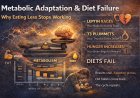
Metabolic adaptation, also called adaptive thermogenesis, refers to a drop in energy expenditure that is greater than what body weight loss alone would predict.
In simple terms:
If someone loses 10 kg, part of the metabolic slowdown is expected because a smaller body burns fewer calories. But research shows the drop in energy expenditure often exceeds that prediction.
That extra suppression is adaptive.
3.1 Resting Metabolic Rate Suppression
Resting metabolic rate accounts for most daily energy expenditure. During prolonged caloric restriction, it can decline because of:
- reduced lean mass
- reduced organ mass
- hormonal changes, especially involving thyroid hormones
This is one reason why calorie targets that once worked eventually stop producing the same result.
3.2 NEAT Reduction
Non-exercise activity thermogenesis includes unconscious movement such as fidgeting, standing, posture changes, and spontaneous walking.
During dieting, NEAT often falls without the person realizing it.
Someone may believe they are “doing everything the same,” while total daily movement quietly decreases.
3.3 Thyroid Hormone Changes
Calorie restriction can lower circulating T3, one of the major hormones involved in metabolic rate regulation.
Even modest reductions can compress the deficit and make fat loss slower.
3.4 Why This Matters Practically
Metabolic adaptation explains why “just eat less” often becomes unsustainable. The body adjusts to the new intake, and the original deficit becomes smaller over time.
For a more direct breakdown of this process, see Metabolic Adaptation Explained.
| Adaptation | Typical Direction During Dieting | Practical Effect |
|---|---|---|
| Resting metabolic rate | Decreases | Fewer calories burned at rest |
| NEAT | Decreases | Less daily movement without noticing |
| T3 | Decreases | Lower metabolic output |
| Hunger signaling | Increases | Harder adherence and greater food focus |
4. The Muscle Loss Feedback Loop
Aggressive dieting often creates a hidden problem: lean mass loss.
Muscle tissue is metabolically expensive. In a perceived energy shortage, the body becomes more willing to reduce tissue that costs energy to maintain, especially if resistance training is absent and protein intake is too low.
4.1 Why the Body Sacrifices Muscle
If calories are very low, cardio is high, and resistance training is missing, the body has fewer reasons to preserve muscle mass.
This creates a self-reinforcing cycle:
lean mass decreases → resting metabolic rate decreases → total energy expenditure decreases → the original deficit becomes less effective → more restriction is applied → muscle loss risk rises further.
4.2 Low Protein Plus High Cardio
The combination of aggressive cardio and low protein intake can:
- reduce muscle protein synthesis
- push net protein balance in a negative direction
- increase fatigue and catabolic stress
Muscle loss during dieting is not inevitable, but it requires protection.
That means protein, resistance training, and a moderate deficit all matter.
For a practical companion piece, read How to Lose Fat Without Losing Muscle.
5. Hormonal Adaptations to Energy Restriction
Dieting changes more than calorie balance. It changes the hormonal environment that regulates hunger, expenditure, and recovery.
5.1 Leptin Suppression
Leptin is secreted by fat cells and communicates energy sufficiency to the brain.
As fat mass declines, leptin tends to fall. The result is a stronger biological signal of energy scarcity, which can increase hunger and reduce energy expenditure.
5.2 Ghrelin Elevation
Ghrelin is often described as the hunger hormone.
During sustained restriction, ghrelin tends to rise, making appetite harder to manage.
5.3 Thyroid Axis Suppression
As noted earlier, reduced calorie intake can suppress thyroid-related metabolic signaling and contribute to lower daily energy expenditure.
5.4 Reproductive Hormone Disruption
In more aggressive or prolonged deficits, low energy availability can disrupt testosterone, estrogen balance, and menstrual regularity.
These are not signs of an efficient fat-loss plan. They are warning signs that recovery and sustainability are being compromised.
| Hormonal Change | Common Dieting Direction | Likely Outcome |
|---|---|---|
| Leptin | Down | More hunger, lower energy expenditure |
| Ghrelin | Up | Stronger appetite drive |
| T3 | Down | Reduced metabolic rate |
| Reproductive hormones | Can become disrupted | Poor recovery and reduced sustainability |
6. Appetite Neurobiology: Why Willpower Is Overrated
Dieting is often framed as a test of discipline. But biology makes that framing incomplete.
6.1 Hypothalamic Regulation
The hypothalamus integrates energy signals such as leptin, ghrelin, insulin, and overall energy status.
When the body senses a deficit, it shifts toward energy conservation and stronger food-seeking behavior.
6.2 Reward Sensitivity
During restriction, high-calorie foods often become more appealing. Reward circuits can become more reactive, especially in food-rich modern environments.
6.3 Ultra-Processed Food Exposure
Ultra-processed foods can intensify reward-driven eating. That makes restrictive dieting even harder to sustain when the food environment is engineered for overconsumption.
In other words, many dieting failures are not simple discipline failures. They are cases of biology colliding with environment.
7. Why Most Commercial Diets Fail Structurally
Many commercial plans are designed for dramatic short-term results, not long-term physiological sustainability.
7.1 Excessive Energy Deficits
Large deficits can produce fast scale loss, but they also accelerate:
- lean mass loss
- metabolic suppression
- hormonal downregulation
- psychological fatigue
7.2 Too Much Cardio, Not Enough Resistance Training
Cardio can help increase expenditure, but high cardio volume without strength training does not adequately preserve lean mass.
Resistance training gives the body a reason to retain muscle during a deficit.
7.3 Insufficient Protein
Many mainstream diet templates fail to raise protein intake enough during calorie restriction.
That makes lean tissue more vulnerable.
7.4 No Exit Strategy
Perhaps the biggest flaw is that many diets have no structured transition phase.
People reach a target weight, then abruptly return to normal eating while metabolic rate is still suppressed and hunger remains elevated.
This creates the perfect setup for fat regain.
8. Why Weight Regain Happens
Weight regain is often treated as proof that the person “failed.” But the physiology of relapse is well-supported.
Common mechanisms include:
- persistent metabolic suppression
- elevated hunger signaling
- reduced spontaneous activity
- lean mass deficits
- restriction backlash in a food-rich environment
These mechanisms create a system that is biased toward regain unless the original dieting design included preservation and maintenance planning.
| Relapse Driver | What Happens | Long-Term Risk |
|---|---|---|
| Persistent metabolic suppression | Energy expenditure stays lower than expected | Maintenance becomes harder |
| Elevated hunger | Appetite remains high after weight loss | Overeating risk rises |
| Lean mass loss | Lower metabolic capacity and worse body composition | Easier fat regain |
| Restriction fatigue | Food preoccupation and rebound behavior increase | Cycle repeats |
Why Weight Loss Often Stops Before Goal Weight
Many people experience a plateau during prolonged dieting because metabolic adaptation gradually reduces the original calorie deficit. As body weight decreases, energy expenditure often falls while hunger signaling increases.
This combination can make continued fat loss progressively harder even when the person believes they are still following the same diet structure. This is one reason sustainable fat-loss plans often require adjustment phases, maintenance periods, and realistic timelines rather than endless restriction.
9. A Physiologically Intelligent Fat-Loss Framework
If diet failure is driven partly by predictable biological adaptation, then better fat-loss design should account for that biology from the beginning.
9.1 Use a Moderate Deficit
Moderate energy deficits tend to preserve lean mass more effectively, reduce the severity of adaptation, and improve adherence.
9.2 Keep Protein High
During a fat-loss phase, protein acts as more than a macronutrient. It helps preserve lean tissue and supports satiety.
9.3 Prioritize Resistance Training
Mechanical tension provides the signal to keep muscle. Without it, the body has less reason to preserve expensive tissue.
9.4 Use Diet Breaks Strategically
Planned periods at maintenance may reduce psychological fatigue and help manage adaptation in longer cuts.
For more on this, read Do Diet Breaks Reset Your Metabolism?.
9.5 Respect Sleep and Recovery
Energy balance is not separate from sleep, fatigue, and recovery status. Poor recovery worsens appetite control, insulin sensitivity, and training performance.
9.6 Plan the Exit
Maintenance is a phase, not an afterthought. Gradual caloric normalization, continued training, and realistic expectations reduce the likelihood of rapid regain.
| Fat-Loss Variable | Better Long-Term Strategy |
|---|---|
| Deficit size | Moderate rather than extreme |
| Protein intake | High enough to support lean-mass retention |
| Training | Resistance training as the foundation |
| Cardio | Supportive, not dominant |
| Diet duration | Managed with breaks when appropriate |
| Post-diet phase | Structured maintenance transition |
Want the practical version of this physiology?
Read How to Lose Fat Without Losing Muscle if your goal is cutting without sacrificing lean mass.
10. Conclusion: Dieting Does Not Fail — Design Fails
The popular story says dieting fails because people are weak.
The literature suggests something more accurate: dieting often fails because the biological costs of restriction were ignored.
Energy restriction triggers coordinated responses:
- lower metabolic rate
- greater hunger
- lean mass vulnerability
- heightened food reward sensitivity
These are survival adaptations, not personal defects.
When fat-loss plans preserve muscle, moderate the deficit, include recovery, and prepare for maintenance, long-term outcomes improve.
Sustainable fat loss is not a battle against biology.
It is a negotiation with it.
References
Anderson, J. W., Konz, E. C., Frederich, R. C., & Wood, C. L. Long-term weight-loss maintenance: A meta-analysis of US studies. The American Journal of Clinical Nutrition.
Berthoud, H. R. Metabolic and hedonic drives in the neural control of appetite. Current Opinion in Neurobiology.
Dulloo, A. G., Jacquet, J., & Montani, J. P. Pathways from weight fluctuations to metabolic diseases. Proceedings of the Nutrition Society.
Fothergill, E., Guo, J., Howard, L., et al. Persistent metabolic adaptation after major weight loss. Obesity.
Forbes, G. B. Body fat content influences the body composition response to nutrition and exercise. Annals of the New York Academy of Sciences.
Hall, K. D. Required energy deficit per unit weight loss. International Journal of Obesity.
Helms, E. R., Aragon, A. A., & Fitschen, P. J. Evidence-based recommendations for contest preparation. Journal of the International Society of Sports Nutrition.
Longland, T. M., Oikawa, S. Y., Mitchell, C. J., et al. Higher protein intake reduces lean mass loss during weight loss. The American Journal of Clinical Nutrition.
Mann, T., Tomiyama, A. J., Westling, E., et al. Diets are not the answer. American Psychologist.
Morton, R. W., Murphy, K. T., McKellar, S. R., et al. Protein supplementation and resistance training. British Journal of Sports Medicine.
Rosenbaum, M., & Leibel, R. L. Adaptive thermogenesis in humans. International Journal of Obesity.
Small, D. M., & DiFeliceantonio, A. G. Processed foods and food reward. Science.
Sumithran, P., Prendergast, L. A., Delbridge, E., et al. Long-term persistence of hormonal adaptations to weight loss. The New England Journal of Medicine.
Trexler, E. T., Smith-Ryan, A. E., & Norton, L. E. Metabolic adaptation to weight loss. Journal of the International Society of Sports Nutrition.
```html
Related Fat Loss and Metabolism Resources
Understanding why diets fail is only part of the equation. These additional guides and reviews may help you build a more sustainable fat-loss strategy.
- Fat Loss and Muscle Retention Guide – learn how to reduce body fat while preserving lean muscle mass.
- Why Most Fat Burners Don't Work – discover what actually makes a supplement effective.
- Best Weight Loss Ebooks – science-based resources for sustainable fat loss.
- CitrusBurn Review – metabolism-support supplement review focused on thermogenesis and fat oxidation.
- Liv Pure Review – liver and metabolism support supplement review.
```
FAQ
Why do most diets fail long-term?
Most diets fail long-term because energy restriction triggers metabolic adaptation, hormonal shifts, increased hunger, and sometimes lean mass loss. These changes make continued fat loss and long-term maintenance harder if the diet is too aggressive or poorly structured.
Does metabolic adaptation permanently damage metabolism?
There is no strong evidence that normal dieting permanently damages metabolism. What usually happens is adaptive suppression that can persist for a while, especially after large weight loss, but it can improve with lean-mass preservation, structured maintenance, and resistance training.
Is slower weight loss better than rapid weight loss?
In many cases, moderate fat loss is easier to sustain because it better protects lean mass, reduces adaptation, and creates less psychological fatigue than aggressive restriction.
How can muscle loss during dieting be reduced?
Muscle loss risk is reduced with high protein intake, progressive resistance training, moderate deficits, and adequate recovery.
Do leptin and ghrelin contribute to weight regain?
Yes. Lower leptin and higher ghrelin after weight loss can increase hunger and reduce expenditure, which can raise the risk of regain if post-diet structure is poor.
What is adaptive thermogenesis?
Adaptive thermogenesis refers to a reduction in energy expenditure during dieting that exceeds what would normally be expected from weight loss alone.
Why do weight loss plateaus happen?
Weight loss plateaus often occur because metabolic adaptation reduces calorie expenditure while hunger signaling increases over time.
Can metabolism recover after dieting?
Metabolic rate may gradually improve with structured maintenance, resistance training, lean-mass recovery, and long-term energy balance normalization.
What is reverse dieting?
Reverse dieting refers to gradually increasing calorie intake after a fat-loss phase to help manage recovery, training performance, and long-term maintenance.