Optimal Protein Intake for Fat Loss & Muscle Preservation | Science-Based Guide
Discover how optimal protein intake supports fat loss, preserves muscle mass, and protects metabolic rate during dieting. Evidence-based strategies included.
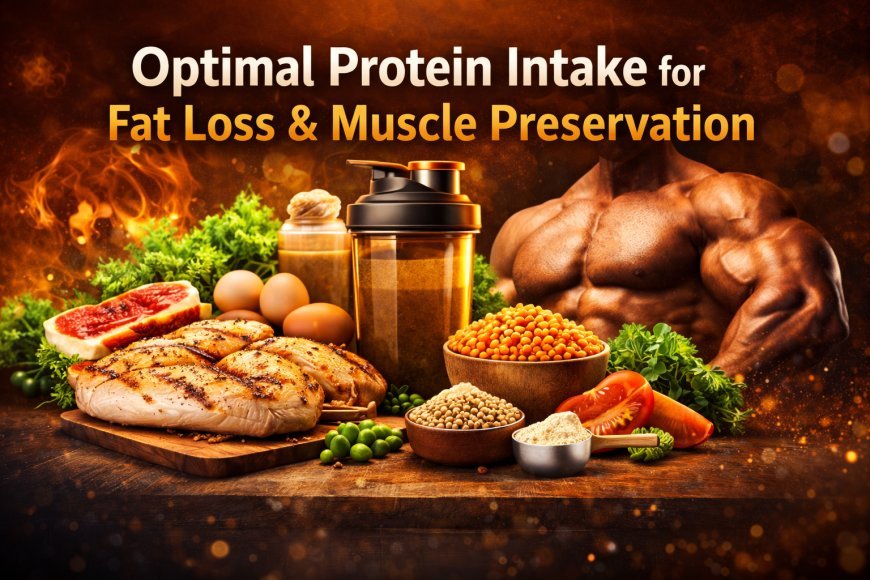
Introduction: Protein Is Not Just About Muscle
Most people associate protein with bodybuilding.
That’s a narrow view.
In the context of fat loss, protein intake for fat loss is one of the most powerful tools available — not because it “burns fat,” but because it preserves what matters most: lean mass and metabolic function.
When calories drop, the body must choose what tissue to lose:
-
Fat
-
Muscle
-
Or both
Without sufficient protein, muscle loss accelerates.
With strategic intake, lean mass can be preserved — even in a deficit.
This article integrates physiology, performance science, and metabolic research into one complete model — forming a core pillar of our broader (Internal link: Metabolic Nutrition Guide).
“Protein intake is just one component of a larger metabolic strategy.”
1. Why Protein Is Metabolically Unique
Protein differs fundamentally from carbohydrates and fats in three key ways:
-
It stimulates muscle protein synthesis (MPS)
-
It has the highest thermic effect of food (TEF)
-
It enhances satiety more than other macronutrients
1.1 Thermic Effect of Protein
The thermic effect of food represents the energy cost of digestion and absorption.
Macronutrient comparison:
-
Protein: ~20–30%
-
Carbohydrates: ~5–10%
-
Fat: ~0–3%
Westerterp (2004) review:
https://pubmed.ncbi.nlm.nih.gov/15090643/
This means that from 100 kcal of protein, up to 30 kcal may be expended during processing.
In dieting contexts, this increased energy expenditure helps offset metabolic adaptation discussed here:
(Internal link: Calorie Deficit & Metabolic Adaptation article)
1.2 Protein and Satiety
High-protein diets reduce hunger more effectively than high-carb or high-fat diets.
Weigle et al. (2005):
High-protein diets increased satiety and spontaneous calorie reduction.
https://pubmed.ncbi.nlm.nih.gov/16002802/
This effect is mediated through:
-
Increased GLP-1
-
Increased PYY
-
Reduced ghrelin
Higher satiety = better adherence = sustainable fat loss.
2. Muscle Protein Synthesis: The Central Mechanism
Muscle mass is regulated by the balance between:
-
Muscle Protein Synthesis (MPS)
-
Muscle Protein Breakdown (MPB)
During a calorie deficit:
MPB increases.
MPS decreases.
If net balance is negative → muscle loss occurs.
Adequate protein requirements for athletes and active individuals counteract this.
2.1 Evidence on Optimal Intake
Morton et al. (2018) meta-analysis:
1.6 g/kg/day maximizes hypertrophy, with benefits up to ~2.2 g/kg/day.
https://pubmed.ncbi.nlm.nih.gov/28698222/
Helms et al. (2014) review for lean athletes:
Suggested 2.3–3.1 g/kg fat-free mass during contest prep to preserve muscle.
https://pubmed.ncbi.nlm.nih.gov/24092765/
Key takeaway:
For fat loss with resistance training:
1.6–2.2 g/kg body weight is evidence-supported.
Lean individuals may benefit from higher ranges.
“To understand how protein integrates with calorie control and hormonal regulation…”
3. Protein Intake During Calorie Deficit
When dieting, protein serves three protective roles:
1️⃣ Preserves Lean Mass
Reduces muscle loss during energy restriction.
2️⃣ Supports Resting Metabolic Rate
Muscle contributes significantly to resting metabolic rate.
3️⃣ Reduces Diet-Induced Metabolic Suppression
Higher protein intake may attenuate adaptive thermogenesis.
PREVIEW study analysis:
Higher protein intake helped counter metabolic decline after weight loss.
https://pubmed.ncbi.nlm.nih.gov/30441763/
4. Protein Distribution & Timing
Total daily intake matters most.
But distribution optimizes outcomes.
4.1 Per-Meal Threshold
Research suggests ~0.4 g/kg per meal maximizes MPS.
For a 75 kg individual:
~30 g protein per meal across 4 meals.
This supports continuous stimulation of muscle protein synthesis.
4.2 Pre- and Post-Workout Protein
Resistance training sensitizes muscle to amino acids.
Consuming protein within several hours of training enhances MPS.
Schoenfeld et al. (2013):
https://pubmed.ncbi.nlm.nih.gov/23360586/
However:
The anabolic window is broader than once believed. Total daily intake remains primary.
5. Protein Quality Matters
Not all protein sources stimulate MPS equally.
Key factor: leucine content.
Animal proteins generally contain higher leucine levels.
Plant-based diets can meet requirements but require:
-
Higher total intake
-
Complementary amino acid pairing
Wolfe (2017) on leucine threshold:
https://pubmed.ncbi.nlm.nih.gov/28642676/
Aim for ~2–3g leucine per meal to maximize MPS.
6. Protein and Fat Loss Efficiency
Higher protein diets improve body composition during weight loss.
Wycherley et al. (2012) meta-analysis:
High-protein diets improved fat mass reduction and preserved lean mass.
https://pubmed.ncbi.nlm.nih.gov/23097268/
Compared to standard protein diets, high-protein approaches:
-
Reduce lean mass loss
-
Improve fat mass percentage
-
Improve satiety
7. Interaction with Carbohydrates & Training
Carbohydrates fuel training performance.
Low carb + low protein = muscle loss risk.
Balanced approach:
-
High protein
-
Strategic carbohydrate timing
Full carb breakdown here:
(Internal link: Carbohydrates, Insulin & Performance Nutrition Explained)
Protein alone cannot compensate for poor training stimulus.
8. How Much Is Too Much?
Beyond ~2.2 g/kg, additional protein shows diminishing returns for muscle growth in most populations.
But during extreme leanness or aggressive dieting, higher intakes may help preserve muscle mass.
Kidney safety?
In healthy individuals, high-protein diets show no adverse kidney effects.
Poortmans & Dellalieux (2000):
https://pubmed.ncbi.nlm.nih.gov/10722779/
9. Protein Intake by Goal
Fat Loss (General Population)
1.6–2.0 g/kg/day
Lean Individuals Cutting
2.0–2.4 g/kg/day
Physique Athletes
2.3–3.1 g/kg fat-free mass
Muscle Gain Phase
1.6–2.2 g/kg/day
10. Practical Implementation Model
Step 1: Calculate body weight
Step 2: Multiply by 1.6–2.2
Step 3: Divide across 3–5 meals
Step 4: Ensure 25–40g per meal
Step 5: Pair with resistance training
11. Common Mistakes
❌ Skipping protein at breakfast
❌ Relying on carbs during deficit
❌ Extreme low-calorie + low-protein dieting
❌ Believing protein alone builds muscle without training
12. Integration Into the Metabolic System
Protein is not isolated.
It works within:
-
Energy balance physiology
-
Metabolic adaptation control
-
Training stimulus
-
Recovery cycles
Full system overview here:
(Internal link: Metabolic Nutrition Guide)
Protein protects lean mass.
Lean mass protects metabolism.
Metabolism determines fat loss sustainability.
Key Takeaways
-
Protein intake for fat loss is foundational for muscle retention.
-
1.6–2.2 g/kg/day is evidence-supported for most active individuals.
-
Protein increases thermic effect of food and satiety.
-
Distribution across meals enhances muscle protein synthesis.
-
High-protein diets improve body composition during deficits.
-
Muscle preservation supports long-term metabolic rate stability.
Scientific References
Morton RW et al. (2018). Protein supplementation and muscle mass.
https://pubmed.ncbi.nlm.nih.gov/28698222/
Helms ER et al. (2014). Evidence-based recommendations for bodybuilding contest prep.
https://pubmed.ncbi.nlm.nih.gov/24092765/
Westerterp KR. (2004). Diet-induced thermogenesis.
https://pubmed.ncbi.nlm.nih.gov/15090643/
Weigle DS et al. (2005). High-protein diet increases satiety.
https://pubmed.ncbi.nlm.nih.gov/16002802/
Wycherley TP et al. (2012). High-protein diets and body composition.
https://pubmed.ncbi.nlm.nih.gov/23097268/
Poortmans JR & Dellalieux O. (2000). High protein intake kidney function study.
https://pubmed.ncbi.nlm.nih.gov/10722779/
Wolfe RR. (2017). Leucine and muscle protein synthesis.
https://pubmed.ncbi.nlm.nih.gov/28642676/
What's Your Reaction?