How to Calculate Your Daily Calorie Needs (Step-by-Step Guide for Fat Loss)
Learn how to calculate your daily calorie needs using BMR, TDEE, activity level, calorie deficit, and macro targets for realistic fat loss or muscle gain.
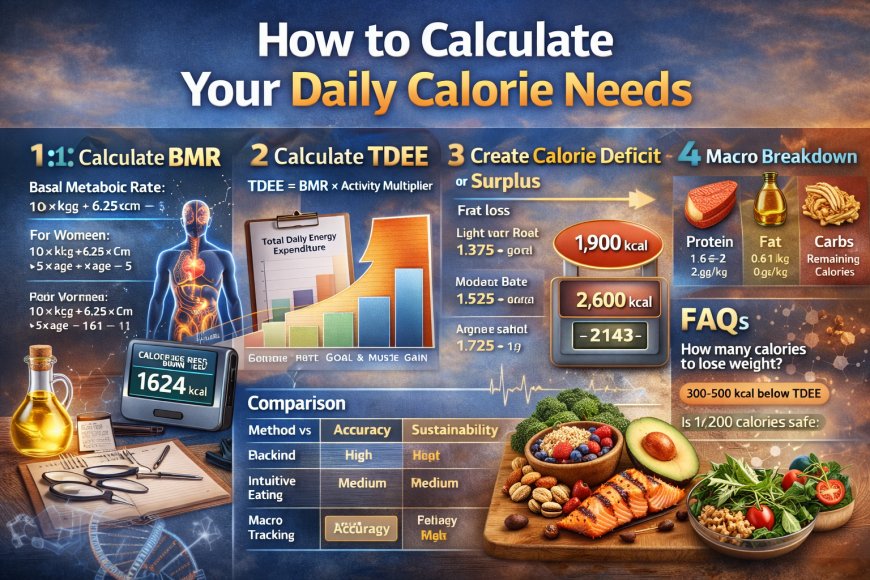
Learning how to calculate your daily calorie needs is one of the most important steps for sustainable fat loss, muscle gain, and long-term body composition improvement.
Many people struggle with weight loss because they rely on guessing instead of understanding how calorie intake, metabolism, activity level, and recovery actually work together.
Your daily calorie needs are influenced by multiple factors including body weight, muscle mass, age, activity level, sleep quality, and overall routine consistency.
This guide explains how to estimate maintenance calories, calculate calorie deficits, understand TDEE and BMR, and build a more realistic nutrition strategy for long-term progress.
What You'll Learn in This Guide
- How to calculate BMR
- How to estimate TDEE
- How calorie deficits work
- How to calculate macros
- Common calorie tracking mistakes
- Why weight loss plateaus happen
- How metabolism adapts during dieting
- Why consistency matters more than perfection
How to Calculate Your Daily Calorie Needs (Step-by-Step Guide)
Understanding your daily calorie needs is one of the most important steps for sustainable fat loss, muscle gain, and long-term body composition improvement.
Most people fail because they guess calories instead of calculating them realistically. Small estimation mistakes repeated every day can completely change results over time.
Your calorie needs depend on:
- body weight
- height
- age
- sex
- muscle mass
- activity level
- daily movement
- exercise routine
- metabolic adaptation
This guide explains how to calculate your maintenance calories, calorie deficit, calorie surplus, and macro targets step by step.
What Are Daily Calorie Needs?
Daily calorie needs represent the amount of energy your body uses every day to survive, move, recover, digest food, and maintain body functions.
This includes:
- breathing
- heart function
- body temperature regulation
- movement
- exercise
- digestion
- recovery
Your body burns calories even when resting.
To better understand metabolism and energy expenditure, read our metabolism and fat-burning guide.
You may also want to read our calorie deficit and metabolic adaptation guide to understand why calorie targets may need adjustment over time.
Step 1: Calculate Your BMR (Basal Metabolic Rate)
Your BMR represents the calories your body burns at complete rest.
The most practical equation is the Mifflin-St Jeor formula.
BMR Formula for Men
10 × weight (kg) + 6.25 × height (cm) − 5 × age + 5
BMR Formula for Women
10 × weight (kg) + 6.25 × height (cm) − 5 × age − 161
Your BMR is not your maintenance calories. It only estimates resting energy expenditure.
Step 2: Calculate TDEE (Total Daily Energy Expenditure)
TDEE estimates how many calories your body burns in a full day including movement, exercise, recovery, and activity.
TDEE = BMR × Activity Multiplier
- Sedentary – 1.2
- Lightly active – 1.375
- Moderately active – 1.55
- Very active – 1.725
- Athlete – 1.9
This gives your estimated maintenance calories.
Many people overestimate activity levels, which creates inaccurate calorie targets.
If you struggle with slow progress, read our guide on why fat loss plateaus happen.
Why Calorie Needs Are Only Estimates
No calorie calculator is perfectly accurate.
Two people with the same body weight may still require different calorie intakes depending on:
- muscle mass
- movement habits
- sleep quality
- stress levels
- hormonal adaptation
- diet history
- daily activity consistency
Your estimated calorie needs should always be adjusted using real-world results over 2–3 weeks.
Many people unknowingly reduce movement, energy expenditure, and activity levels during long dieting phases. This is one reason metabolic adaptation can slow progress over time.
Read our metabolic adaptation explained guide to understand how the body adapts during fat loss phases.
Track:
- body weight trends
- hunger levels
- energy
- training performance
- recovery
- sleep quality
Step 3: Create a Calorie Deficit or Surplus
For Fat Loss
- Moderate deficit: −300 to −500 kcal
- Aggressive deficit: −700 kcal (short-term only)
Moderate deficits are usually more sustainable long term.
Extreme restriction often increases:
- hunger
- fatigue
- metabolic adaptation
- muscle loss risk
- diet inconsistency
To understand why aggressive dieting often fails, read our why dieting fails guide.
For Muscle Gain
- Small surplus: +200 to +300 kcal
Large surpluses usually increase unnecessary fat gain instead of muscle growth efficiency.
Step 4: Macro Breakdown for Weight Loss
Calories determine weight change. Macros strongly influence body composition, recovery, satiety, and muscle retention.
This is one reason two people eating the same calories may still experience different results depending on:
- protein intake
- food quality
- training intensity
- muscle mass
- sleep quality
- stress management
- recovery consistency
Calories matter, but body composition and long-term sustainability are influenced by many additional factors.
To understand how nutrition quality affects metabolism and performance, read our metabolic nutrition guide.
Protein
1.6–2.2g per kg bodyweight
Protein helps:
- preserve muscle mass
- improve satiety
- support recovery
- maintain metabolic rate
Read our protein intake for fat loss guide.
Fat
0.6–1g per kg bodyweight
Healthy fats support:
- hormone function
- recovery
- satiety
- nutrient absorption
Carbohydrates
Remaining calories after protein and fats are set.
Carbohydrates mainly support:
- training performance
- recovery
- glycogen replenishment
- exercise intensity
For advanced nutrition fundamentals, read our nutrition and metabolism guide.
Common Mistakes When Calculating Calories
- Overestimating activity levels
- Ignoring liquid calories
- Using unrealistic calorie deficits
- Tracking inconsistently
- Adjusting calories too aggressively
- Not accounting for weekends
- Ignoring sleep quality and recovery
- Expecting rapid short-term results
Why Some People Stop Losing Weight Even in a Calorie Deficit
Many people assume calorie deficits stop working when weight loss slows down.
In reality, several factors may reduce progress over time:
- reduced daily movement
- metabolic adaptation
- poor sleep quality
- inconsistent calorie tracking
- weekend overeating
- stress-related eating
- water retention
- muscle loss from aggressive dieting
This is why sustainable fat loss usually works better with moderate calorie deficits and long-term consistency instead of extreme restriction.
If you feel stuck despite eating less, read our why you're not losing fat guide.
Comparison Table
| Method | Accuracy | Ease | Sustainability |
|---|---|---|---|
| Manual Tracking | High | Medium | High |
| Intuitive Eating | Low (Beginner) | High | Medium |
| Extreme Low-Calorie Diet | Short-Term High | Low | Very Low |
| Macro Tracking | Very High | Medium | High |
Why Consistency Matters More Than Perfection
Many people constantly switch diets, calorie targets, or nutrition strategies before giving the body enough time to adapt.
Sustainable progress usually comes from:
- consistent tracking
- realistic calorie targets
- adequate protein intake
- sleep quality
- recovery management
- long-term routine consistency
Many people search for the “perfect” calorie number, but real-world fat loss is rarely that precise.
Sleep quality, stress, hydration, hormones, digestion, recovery, training intensity, and routine consistency may all influence short-term scale changes.
This is why successful long-term fat loss usually depends more on consistency and realistic adjustments than perfection.
To understand why metabolism changes during dieting, read our metabolic adaptation guide.
Frequently Asked Questions
How many calories should I eat to lose weight?
Most people start with a 300–500 calorie deficit below maintenance and adjust based on progress over several weeks.
What is TDEE?
TDEE stands for Total Daily Energy Expenditure. It estimates how many calories your body burns in a full day including movement and exercise.
How often should I recalculate calorie needs?
Recalculate when body weight changes significantly or activity levels change.
Do macros matter if calories are controlled?
Yes. Macros influence recovery, hunger, muscle retention, performance, and body composition.
Is 1200 calories too low?
For many adults, yes. Extremely low calorie intake may increase fatigue, hunger, and diet inconsistency.
Why am I not losing weight in a calorie deficit?
Inconsistent tracking, water retention, poor sleep, reduced activity levels, metabolic adaptation, and inaccurate calorie estimates may all slow visible progress.
Should I eat below my BMR?
Extremely low calorie intake below estimated BMR levels may increase fatigue, muscle loss risk, hunger, and diet inconsistency for many people.
How accurate are calorie calculators?
Most calorie calculators only provide estimates. Real-world calorie needs often require adjustments based on progress, body composition, activity, and consistency.
Can metabolism slow down during dieting?
Yes. Long-term aggressive dieting may reduce energy expenditure, movement, recovery, and metabolic efficiency over time.
Does sleep affect calorie burning?
Sleep quality may influence hunger hormones, recovery, energy expenditure, cravings, training performance, and overall consistency.
Final Thoughts
Calculating calorie needs gives structure to your nutrition strategy.
Without realistic calorie awareness, most people rely on guessing, emotional eating, or extreme dieting cycles.
The most sustainable approach is usually:
- moderate calorie control
- high consistency
- adequate protein intake
- realistic expectations
- long-term routine sustainability
Related Fat Loss & Nutrition Guides
To continue improving your nutrition and metabolism knowledge, explore these evidence-based guides:
- Metabolism Explained: Fat Burning Guide
- Calorie Deficit & Metabolic Adaptation
- Why Fat Loss Plateaus Happen
- Protein Intake for Fat Loss & Muscle Preservation
- Metabolic Adaptation Explained
- Nutrition Fundamentals & Metabolism
Precision matters, but consistency matters even more.