Calorie Deficit & Metabolic Adaptation: Science of Sustainable Fat Loss
Discover how calorie deficits trigger metabolic adaptation, why fat loss stalls, and how to preserve muscle and metabolic rate with evidence-based strategies.
What Is Metabolic Adaptation?
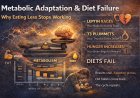
Metabolic adaptation is the reduction in energy expenditure that occurs during prolonged calorie restriction and weight loss. The body responds to dieting by lowering metabolic rate, reducing spontaneous movement, increasing hunger, and conserving energy.
Introduction: Why Most Fat Loss Advice Fails
Everyone repeats the same rule:
“To lose fat, you must be in a calorie deficit.”
That statement is physiologically correct, but strategically incomplete.
A calorie deficit is necessary for fat loss. It is not, by itself, sufficient for sustainable fat loss.
When energy intake drops, the human body does not passively comply. It adapts. It reduces energy expenditure, shifts hormones, and even alters behavior subconsciously.
This biological resistance is called metabolic adaptation.
If you ignore it, fat loss becomes harder over time. If you understand it, you can manage it far more effectively.
This article explains the physiology behind fat loss by integrating energy balance, adaptive thermogenesis, and muscle preservation into one practical framework. For the broader system, read our Metabolic Nutrition Guide.
For a broader understanding of how calories, hormones, and macronutrients interact, read our complete fat loss nutrition framework.
1. What Is a Calorie Deficit — Mechanistically?
At its simplest:
Fat loss occurs when energy expenditure exceeds energy intake.
But energy expenditure is not one single number. It is made up of several components:
- Resting Metabolic Rate (RMR) – energy used at rest
- Thermic Effect of Food (TEF) – the energy cost of digestion
- Exercise Activity Thermogenesis (EAT) – planned exercise
- Non-Exercise Activity Thermogenesis (NEAT) – spontaneous daily movement
Total Daily Energy Expenditure (TDEE) is the sum of all of these factors.
When calorie intake drops, these components do not stay fixed.
They often decline.
2. Metabolic Adaptation: The Biological Pushback
2.1 Definition
Metabolic adaptation, also called adaptive thermogenesis, is the reduction in energy expenditure beyond what would be expected from changes in body mass alone.
In simpler terms:
You burn fewer calories than expected after losing weight.
For a broader understanding of how calories, hormones, and macronutrients interact, read our complete fat loss nutrition framework.
2.2 Landmark Evidence
Leibel, Rosenbaum & Hirsch (1995)
Participants who lost 10% of body weight experienced a greater-than-predicted reduction in energy expenditure.
Rosenbaum & Leibel (2010)
This review described how metabolic adaptation can persist after weight loss.
The core conclusion was that reduced energy expenditure is part of the body’s biological defense against weight loss.
Fothergill et al. (2016) – The Biggest Loser Study
Years after major weight loss, participants still showed suppressed metabolic rates.
That is not a trivial effect.
2.3 Mechanisms Behind Adaptive Thermogenesis
Metabolic adaptation occurs through several mechanisms:
1. Reduced Resting Metabolic Rate
Loss of body mass explains part of the decline, but not all of it.
2. Decreased NEAT
People often move less subconsciously while dieting.
3. Hormonal Changes
- leptin decreases
- thyroid hormones decrease
- ghrelin increases
- sympathetic nervous system activity may drop
These changes increase hunger and reduce energy output.
3. Why Aggressive Dieting Backfires
Crash dieting tends to amplify adaptation.
Research reviews on metabolic adaptation describe how severe energy restriction can accelerate:
- lean-mass loss
- declines in resting metabolic rate
- hormonal disruption
This raises the risk of:
- fat loss plateaus
- rebound weight gain
- reduced training performance
Extreme deficits are not efficient. They are metabolically expensive.
4. Muscle Loss: The Hidden Driver of Metabolic Slowdown
When you diet without resistance training or sufficient protein, lean mass tends to decrease.
Because muscle tissue contributes meaningfully to resting metabolic rate, muscle loss compounds metabolic suppression.
We break down protein strategy in more detail in our Protein Intake for Fat Loss and Muscle Preservation Guide.
Here is the key point:
If you lose 5 kg and 2 kg of that is muscle, your metabolic rate typically drops more than if all 5 kg came from fat.
Muscle preservation is not cosmetic. It is metabolic insurance.
5. Energy Balance Is Dynamic, Not Linear
Many people assume:
“A 500-calorie deficit means 0.5 kg lost every week forever.”
That is not how the body works.
Dynamic models of energy balance show that energy expenditure adapts over time.
Weight loss slows because:
- TDEE declines
- hormonal responses shift
- the body becomes more efficient
This is why early weight loss is often faster and later phases slow down.
The body resists change.
6. The Role of Diet-Induced Thermogenesis
Not all calories behave identically in the body.
The Thermic Effect of Food (TEF) differs by macronutrient:
- Protein: 20–30%
- Carbohydrates: 5–10%
- Fat: 0–3%
Higher protein intake can slightly increase daily energy expenditure.
That is one reason protein intake for fat loss is so important when trying to reduce metabolic slowdown.
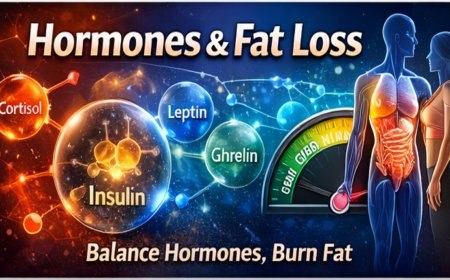
7. Hormonal Adaptations During Calorie Restriction
Leptin
Leptin is produced by fat cells and helps signal energy sufficiency.
During fat loss, leptin often drops sharply.
This can lead to:
- increased hunger
- reduced metabolic rate
Thyroid Hormones
T3 often declines during prolonged calorie restriction.
Lower T3 generally means a lower metabolic rate.
Ghrelin
Ghrelin increases appetite.
The combined effect of these hormonal changes is simple: the body tries to restore lost weight.
This is not weakness. It is physiology.
8. The Fat Loss Plateau: What Actually Causes It?
A fat loss plateau usually occurs when:
Calorie intake equals your adapted TDEE.
Common causes include:
- an initial deficit eventually becomes maintenance
- NEAT decreases without you noticing
- tracking errors build up over time
- muscle loss reduces resting metabolic rate
- hormonal adaptation increases appetite
Plateaus are not mysterious. They are predictable.
9. Strategic Deficit Model (Evidence-Based)
Rather than using aggressive restriction, a better model usually looks like this:
Step 1: Moderate Deficit (15–20%)
This helps reduce the speed of adaptation.
Step 2: High Protein (1.6–2.2 g/kg)
This helps preserve muscle and resting metabolic rate.
For the detailed breakdown, read our Protein Intake Guide.
Step 3: Resistance Training
This helps maintain lean tissue.
Step 4: Strategic Diet Breaks
Short periods at maintenance may help restore leptin and reduce some metabolic suppression.
Research on intermittent energy restriction suggests that diet breaks may help preserve more resting metabolic rate than continuous dieting in some cases.
10. Carb Intake and Performance During a Deficit
Carbohydrates help fuel high-intensity exercise.
Low glycogen reduces performance, and reduced performance can lower training volume.
Lower training stimulus means a higher risk of muscle loss.
For the full explanation, read our Carbohydrates, Insulin & Performance Nutrition Guide.
Strategic carbohydrate timing can help maintain:
- strength
- muscle mass
- training output
That indirectly helps protect metabolic rate.
11. Psychological Adaptation: The Behavioral Layer
Metabolic adaptation is not only hormonal.
Behavior adapts too.
- reduced spontaneous movement
- increased food preoccupation
- reduced motivation
NEAT reduction alone can account for hundreds of calories per day.
You may feel like you are doing the same amount of activity, but objectively you may not be.
12. Why Weight Regain Is Common
After dieting:
- metabolic rate may remain suppressed
- appetite may remain elevated
This is one reason weight regain is so common within the first few years after a diet.
The system is biased toward restoration.
Diet Fatigue and Energy Conservation
Prolonged calorie restriction may also increase diet fatigue, reduce motivation, and increase subconscious energy conservation behaviors.
These adaptations can lower total daily energy expenditure even when formal exercise remains unchanged.
13. Practical Implementation Framework
To minimize metabolic adaptation:
Avoid Extreme Deficits
Severe restriction tends to create severe adaptation.
Preserve Muscle
Lift weights 3–5 times per week.
Eat High Protein
This supports TEF and muscle retention.
Track Objectively
Adjust intake as body weight decreases.
Plan Maintenance Phases
This can help reduce chronic suppression.
14. Advanced Insight: Adaptation Is Proportional to Fat Loss Speed
Rapid weight loss increases:
- lean-mass loss
- hormonal suppression
- declines in resting metabolic rate
Slower fat loss generally preserves metabolic function better.
This is not “slow dieting.” It is strategic dieting.
15. The Metabolic Reality Check
Here is the uncomfortable truth:
Your body does not naturally want to become very lean.
From an evolutionary perspective, body fat acts like survival insurance.
So when you try to reduce it, the body often pushes back.
Understanding that changes the way you see plateaus:
They are not failure.
They are biological resistance.
16. Integration Into the Metabolic Nutrition System
This article is one pillar of the larger system.
For the full framework, read our Metabolic Nutrition Guide.
That system integrates:
- energy balance
- macronutrient strategy
- hormonal adaptation
- muscle preservation
- training performance
Without integration, deficits eventually fail.
Key Takeaways
- A calorie deficit is necessary, but it is not static.
- Metabolic adaptation reduces energy expenditure over time.
- Muscle preservation is critical for maintaining resting metabolic rate.
- Protein intake and resistance training help blunt adaptation.
- Strategic pacing helps prevent severe hormonal suppression.
- Fat loss plateaus are physiological, not personal weakness.
Final Thoughts
A calorie deficit is the starting point of fat loss, not the full strategy.
Long-term results depend on how well you manage muscle retention, training performance, recovery, hormones, and adherence while dieting.
That is what makes the difference between temporary weight loss and sustainable fat loss.
If your results don’t match your effort, this guide explains why results don’t happen even with effort and what might be happening behind the scenes.
Frequently Asked Questions
What is metabolic adaptation?
Metabolic adaptation refers to the reduction in energy expenditure that occurs during prolonged dieting and weight loss.
Why does fat loss slow down over time?
Fat loss often slows because total daily energy expenditure decreases as body weight drops and metabolic adaptation develops.
What is adaptive thermogenesis?
Adaptive thermogenesis is the body's biological response to conserve energy during calorie restriction.
Can muscle loss reduce metabolism?
Yes. Losing lean muscle mass may lower resting metabolic rate and contribute to metabolic slowdown.
Do diet breaks help metabolism?
Strategic diet breaks may help reduce some hormonal and metabolic adaptations associated with prolonged calorie restriction.