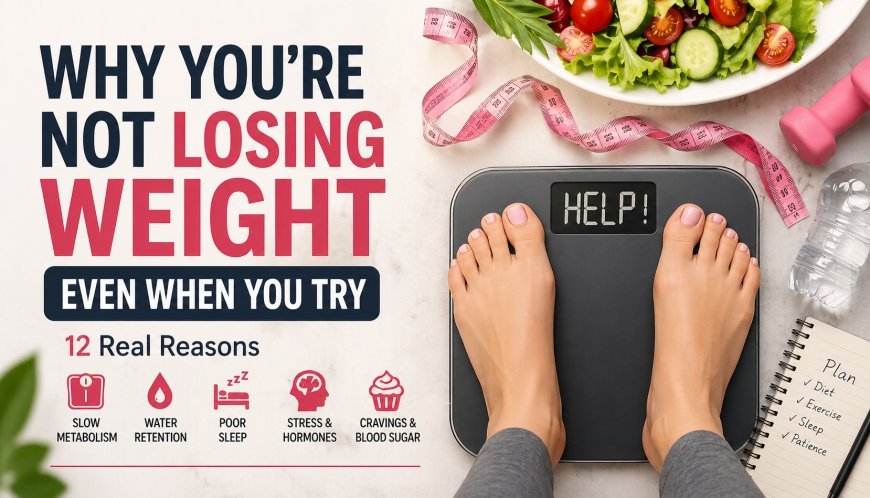
Why You’re Not Losing Weight Even When You Try: 12 Real Reasons
Not losing weight even when eating better? Learn the real reasons fat loss stalls, from metabolism and water retention to sleep, stress, gut health, and blood sugar.
Quick Answer
If you are not losing weight even when you try, it does not automatically mean you are failing.
Common reasons include water retention, metabolic adaptation, hidden calories, low protein intake, poor sleep, stress, reduced daily movement, gut issues, blood sugar swings, and unrealistic expectations.
The scale measures more than fat. It also reflects water, digestion, sodium, hormones, stress, food volume, and sleep quality.
Best first step: do not change everything at once. Review sleep, protein, portions, movement, stress, and consistency before making extreme adjustments.
Weight Loss Stuck Even Though You’re Trying?
Many people assume no progress means they need to diet harder.
But weight loss often stalls because of adaptation, water retention, poor sleep, stress, or hidden calorie intake.
This guide helps you identify the real reason before making unnecessary changes. Understand Metabolic Adaptation
Table of Contents
Why Am I Not Losing Weight Even When I Try?
You may be eating better, moving more, drinking more water, and trying to stay consistent.
But the scale still may not move.
That does not always mean your plan is failing.
Weight loss can stall for many reasons:
- Your body may be holding water.
- Your metabolism may have adapted.
- Your calorie intake may be higher than expected.
- Your sleep may be affecting hunger and recovery.
- Your stress level may be disrupting consistency.
- Your daily movement may have dropped.
The key is to identify the real reason instead of guessing.
For a broader explanation, read Metabolism Explained Simply.
1. You May Be Losing Fat but Holding Water
The scale does not only measure body fat.
It also reflects:
- Water retention
- Sodium intake
- Carbohydrate intake
- Digestion
- Food volume
- Stress
- Poor sleep
- Hormonal changes
This means your body can be improving even when the scale looks stuck.
A sudden weight increase after a salty meal or poor sleep does not automatically mean fat gain.
If water balance is a recurring issue, you may find this helpful: Aqua Sculpt Review.
2. Your Metabolism Adapts Over Time
Your metabolism is not fixed.
It changes based on:
- Body size
- Muscle mass
- Food intake
- Activity level
- Sleep quality
- Stress
- Long-term habits
As you lose weight, your body often burns fewer calories than before.
This is normal.
It does not mean your metabolism is broken.
It means your body is adapting.
Read the full explanation here: Metabolic Adaptation Explained.
3. You Are Eating Better, but Still Eating More Than You Think
Food quality matters.
But calories still matter too.
Many healthy foods are easy to underestimate:
- Nuts
- Oils
- Smoothies
- Protein bars
- Sauces
- Creamers
- Granola
- Restaurant meals
This does not mean you need to obsess over every bite.
But if progress has stopped, tracking portions honestly for a few days can reveal useful patterns.
4. You Are Not Eating Enough Protein
Protein supports fullness, recovery, muscle retention, and body composition.
If your meals are low in protein, hunger may return quickly.
This can make consistency harder.
Protein-rich options include:
- Eggs
- Greek yogurt
- Chicken
- Fish
- Lean meat
- Tofu
- Cottage cheese
- Beans and lentils
Helpful guide: Optimal Protein Intake Guide.
5. Your Sleep Is Working Against You
Sleep affects weight loss more than most people realize.
Poor sleep may increase:
- Cravings
- Hunger
- Stress
- Fatigue
- Low motivation
When sleep is poor, many people move less and snack more without noticing.
That can make fat loss harder even when the diet looks good on paper.
Read more: Sleep and Weight Loss Guide.
Need Help Understanding Weight Fluctuations?
Sometimes the issue is not fat gain. It may be water retention, sleep, stress, or metabolic adaptation. Read Metabolism Guide
6. Stress Is Keeping Your Body in Survival Mode
Stress does not magically create fat overnight.
But it can absolutely make fat loss more difficult.
Chronic stress may affect:
- Sleep quality
- Cravings
- Water retention
- Motivation
- Digestion
- Consistency
When stress is high, people often either eat more than they realize or restrict too aggressively and eventually rebound.
Neither pattern is sustainable.
7. You Are Moving Less Than You Think
Exercise matters.
But daily movement matters too.
Many people work out for 30–60 minutes and then spend most of the day sitting.
Daily activities such as:
- Walking
- Standing
- Cleaning
- Taking stairs
- Housework
- General movement
all contribute to calorie expenditure.
Small movements add up over time.
8. Your Gut Health May Affect Consistency
Gut health does not replace calories or exercise.
But digestion influences how you feel every day.
People who frequently experience:
- Bloating
- Discomfort
- Irregular digestion
- Poor appetite regulation
often find it harder to maintain healthy habits.
Helpful guide:
Gut Health and Weight Loss Explained
Some readers also explore:
9. Blood Sugar Swings May Increase Cravings
Large fluctuations in blood sugar may lead to:
- Energy crashes
- Frequent hunger
- Cravings
- Reduced consistency
Balanced meals that include protein, fiber, and healthy fats often support steadier energy.
Related guides:
10. You Keep Changing Plans Too Quickly
This is one of the most common mistakes.
People often switch diets before giving their body enough time to respond.
A simple plan followed consistently for 30 days usually teaches you more than five different plans followed for a few days each.
Consistency beats constant change.
11. Supplements Are Support Tools, Not Magic Solutions
Supplements may support a routine.
But they cannot replace:
- Sleep
- Nutrition
- Movement
- Stress management
- Consistency
Think of supplements as additions—not foundations.
Related reviews:
12. Your Expectations May Be Too Fast
Healthy fat loss is usually slower than people expect.
Progress can appear in many forms:
- Better sleep
- Improved energy
- Reduced cravings
- Less bloating
- Better workouts
- Greater consistency
The scale is useful.
But it is not the only sign of progress.
What Should You Do If Weight Loss Is Stuck?
Before making extreme changes, review the basics:
- Are you sleeping enough?
- Are you eating enough protein?
- Are your portions realistic?
- Are you moving daily?
- Are stress and cravings connected?
- Have you given your plan enough time?
Helpful resources:
A Simple 7-Day Reset Plan
If you feel stuck, try this for one week:
- Walk 20–30 minutes daily.
- Include protein with each meal.
- Drink more water.
- Sleep consistently.
- Reduce liquid calories.
- Track bloating patterns.
- Avoid weighing yourself multiple times a day.
This is not a crash diet.
It is a clarity plan.
Progress Slower Than Expected?
Most plateaus do not require extreme action.
They usually require better awareness and consistency. Understand Fat Loss Plateaus
When Should You Look Deeper?
Sometimes, weight loss resistance has deeper causes.
If you are doing the basics well and still feel completely stuck, it may be worth discussing your situation with a qualified healthcare professional.
Possible factors include:
- Hormonal changes
- Thyroid issues
- Medication side effects
- Digestive disorders
- Insulin resistance
- Sleep disorders
- Chronic stress
This article is educational and should not replace medical advice.
Final Thoughts
If you are not losing weight even when you are trying, it does not mean you are lazy or broken.
Most plateaus happen because something inside the system needs attention.
Maybe it is:
- Sleep
- Stress
- Protein intake
- Daily movement
- Water retention
- Blood sugar regulation
- Digestive health
- Consistency
The goal is not to blame yourself.
The goal is to identify what is actually limiting your progress.
Once you understand the cause, weight loss becomes much less confusing.
Reality Check
Healthy fat loss is usually slower than social media suggests.
Progress is not always linear.
Temporary stalls are normal.
The scale is only one tool.
Other signs of progress include:
- Better energy
- Reduced cravings
- Improved sleep
- Better workouts
- Less bloating
- Greater consistency
Results vary, but consistency almost always wins.
Scientific References and Authority Sources
- National Institutes of Health (NIH)
- PubMed Research Database
- Harvard T.H. Chan School of Public Health
- Centers for Disease Control and Prevention (CDC)
- National Heart, Lung, and Blood Institute
Related Guides
- Metabolism Explained
- Metabolic Adaptation Explained
- Fat Loss Plateau Explained
- Why a Calorie Deficit May Not Be Working
- Optimal Protein Intake Guide
- Sleep and Weight Loss Guide
- Gut Health and Weight Loss Explained
- Carbohydrates and Insulin Explained
Related Reviews
- Aqua Sculpt Review
- LeanBiome Review
- Mitolyn Review
- Java Burn Review
- GlucoTrust Review
- Sugar Defender Review
Frequently Asked Questions
Why am I not losing weight even when I try?
Common reasons include water retention, stress, sleep problems, hidden calories, metabolic adaptation, and reduced daily activity.
Can water retention hide fat loss?
Yes. Temporary water retention may prevent the scale from reflecting real fat loss.
Is my metabolism broken?
Usually no. Metabolism adapts rather than breaks.
Can poor sleep stop weight loss?
Poor sleep may increase cravings and reduce consistency, making fat loss harder.
Can stress affect body weight?
Yes. Stress can influence hunger, sleep, cravings, and water retention.
Do I need to eat less?
Not always. Sometimes meal quality, protein intake, and consistency matter more than eating less.
Can blood sugar swings increase cravings?
Yes. Large fluctuations may make appetite harder to control.
Can gut health influence weight loss?
Indirectly, yes. Digestive comfort affects consistency and eating habits.
Why does weight loss slow down?
Metabolic adaptation and reduced energy expenditure are normal responses.
Should I change diets every week?
No. Consistency usually produces better long-term results.