Why You’re Not Losing Fat in a Calorie Deficit (Real Reasons + Fix)
Not losing fat in a calorie deficit? Discover the real reasons fat loss stops, how metabolism adapts, and proven ways to break a plateau and start losing weight again.
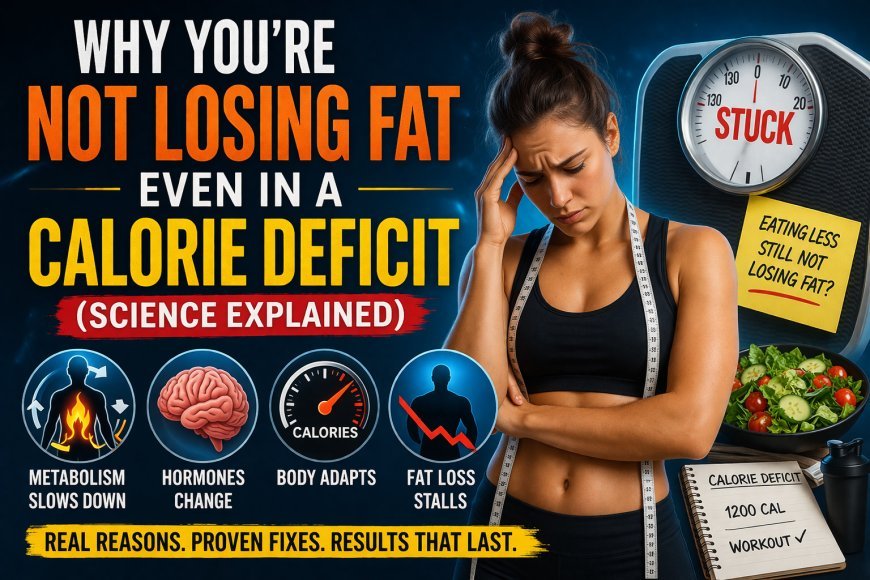
Quick Answer: Why You’re Not Losing Fat Even in a Calorie Deficit
If you are not losing fat in a calorie deficit, the most common reasons are inaccurate calorie tracking, reduced daily movement, metabolic adaptation, water retention, poor sleep, stress, and inconsistent weekends. A true calorie deficit still works, but what you think is a deficit may no longer be a real deficit once your body adapts and your daily energy output drops.
- Most common cause: hidden calorie intake or inaccurate tracking
- Most overlooked cause: reduced daily movement and lower NEAT
- Most misunderstood factor: water retention hiding real fat loss
- Biggest mistake: cutting calories harder before checking the system
- Best first step: audit calories, steps, protein, sleep, and weekly averages
Why You’re Not Losing Fat Even in a Calorie Deficit: Science-Based Reasons and How to Fix It
You are eating less. You are training hard. You are trying to stay consistent.
But the scale is not moving.
This is one of the most common fat-loss problems. It is also one of the most misunderstood.
Many people assume a calorie deficit should always lead to steady weekly weight loss. In theory, that is true. In real life, the body is more complex.
Your metabolism adapts. Hunger changes. Daily movement drops. Water retention can hide progress. Sleep and stress can make adherence harder. Your routine may become easier for your body to handle.
That is why fat loss can slow down, stall, or feel completely stuck even when you think you are doing everything right.
This guide explains why a calorie deficit may stop producing visible results, what metabolic adaptation actually means, how to tell the difference between a real plateau and water-weight noise, and what to do next without panicking or over-restricting.
If you want the broader framework after this article, read our ultimate science-based fat loss guide. For a deeper explanation of calorie balance and adaptation, read calorie deficit and metabolic adaptation.
The Truth About a Calorie Deficit
A calorie deficit means you burn more energy than you consume.
This is the foundation of fat loss.
But many people simplify this idea too much.
The human body is not a calculator. It is a survival system.
When food intake drops for days or weeks, the body responds. It tries to protect energy. It tries to reduce waste. It becomes more efficient.
This can show up in several ways:
- You move less without noticing.
- Your workouts feel harder.
- Your hunger increases.
- Your recovery gets worse.
- Your daily calorie burn drops.
- You become less active outside the gym.
- Your body holds more water during stress or hard training.
This does not mean calories do not matter.
Calories still matter.
It means your calorie deficit is dynamic, not fixed.
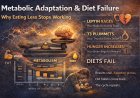
The deficit you created at the beginning of a diet may shrink over time as body weight drops, daily movement decreases, and metabolic adaptation occurs.
If you want a deeper explanation of how long-term dieting changes energy balance, read this guide on calorie deficit and metabolic adaptation.
Does a Calorie Deficit Always Work?
In theory, a true calorie deficit always leads to fat loss over time.
In real life, the problem is often this:
What used to be a deficit may no longer be a real deficit.
Your body can adapt by:
- reducing spontaneous movement
- lowering training output
- making you feel more tired
- increasing hunger and cravings
- reducing non-exercise activity thermogenesis
- making adherence harder
That means your planned deficit and your actual deficit may not match.
This is why many people feel stuck even though they believe they are doing everything right.
Why You’re Not Losing Fat Even in a Calorie Deficit
1. Your Body Has Reduced Energy Output
This is one of the biggest reasons progress slows down.
When you diet, your body often burns fewer calories than before. This is partly because you weigh less. A smaller body usually burns fewer calories.
But that is not the whole story.
Your body may also reduce energy output through metabolic adaptation.
You may notice:
- lower energy
- less spontaneous movement
- weaker gym performance
- more fatigue during the day
- less motivation to walk or move
If you want to understand this process better, see this article on metabolic adaptation.
2. You Are Eating More Than You Think
This is extremely common.
It does not mean you are lazy or careless. It means tracking food is harder than most people realize.
Small things add up fast:
- cooking oils
- liquid calories
- healthy snacks
- extra bites while cooking
- larger weekend meals
- restaurant meals
- untracked sauces and dressings
- small portions that are larger than estimated
A small mismatch between what you think you eat and what you actually eat can erase the deficit.
This is especially common when weekdays are controlled but weekends are loose.
3. Water Retention Is Hiding Real Fat Loss
Sometimes fat loss is happening, but the scale is not showing it yet.
Water retention can mask progress for days or even weeks.
This often happens when:
- stress is high
- sleep is poor
- sodium intake changes
- carbohydrate intake changes
- training volume increases
- muscle soreness is high
- menstrual cycle changes affect fluid balance
That is why scale weight alone can be misleading.
Progress photos, waist measurements, gym performance, and how your clothes fit can tell a clearer story.
4. Your Activity Dropped Without You Noticing
Many people think only workouts matter.
Workouts do matter.
But daily movement matters too.
When calories are low, people often walk less, sit more, and move less between tasks.
This drop in daily movement can be large enough to reduce the fat loss you expected.
You may still be doing your workouts, but your total daily calorie burn may be lower than before.
5. Your Body Adapted to Your Routine
If you do the same training plan for too long, the body becomes more efficient at it.
This does not mean the routine is bad.
It means it may no longer create the same challenge.
Progress often slows when training intensity, effort, step count, or progression stop improving.
6. Hunger and Recovery Got Worse
The longer a diet lasts, the harder it becomes to stay precise.
Hunger increases. Cravings rise. Sleep may suffer. Mood may drop. Recovery may get worse.
All of this makes consistency harder.
It also increases the chance of overeating during stressful moments.
Hormones can play a role here too. If you want a broader view, read this guide on hormones and fat loss.
7. You Hit a Normal Fat Loss Plateau
Fat loss is rarely linear.
It does not move in a straight line every week.
Some weeks are fast. Some are slow. Some feel frozen.
A plateau does not always mean failure. It often means your body needs a better strategy.
For a more detailed breakdown, read this fat loss plateau guide.
Why You’re Not Losing Weight But Look Leaner
In some cases, fat loss is happening, but the scale does not reflect it.
This can happen when:
- you are building or maintaining muscle
- water retention increases
- inflammation from training is high
- your waist is shrinking but scale weight is stable
- your body composition is improving slowly
This is why relying only on scale weight can be misleading.
If your waist is smaller, clothes fit better, and progress photos look different, you may still be making progress even if the scale is slow.
Need a Better Fat Loss Strategy?
If dieting harder is not working, the answer is usually not more restriction. It is a smarter approach to metabolism, recovery, and consistency.
Signs Your Metabolism May Have Adapted
Not every stall means your metabolism is broken.
But some signs can suggest your body has adjusted to your deficit.
- You feel colder than usual.
- Your energy is lower.
- Your gym performance is worse.
- You feel hungrier than usual.
- You are losing motivation.
- Your weight has stopped changing for several weeks.
- Your daily movement is lower.
- You feel more tired after normal tasks.
- You crave high-calorie foods more often.
- Your sleep quality has declined.
These signs do not mean your body is damaged.
They usually mean it is adapting.
That is a normal biological response. The goal is not panic. The goal is adjustment.
Fat Loss Plateau Checklist
Before cutting calories harder, run through this checklist.
| Check | What to Review | Why It Matters |
|---|---|---|
| Calories | Are oils, snacks, sauces, weekends, and drinks tracked? | Hidden calories can erase the deficit. |
| Protein | Are you eating enough protein daily? | Protein supports fullness and muscle retention. |
| Steps | Did daily movement drop? | Lower NEAT can shrink your deficit. |
| Sleep | Are you sleeping enough? | Poor sleep increases hunger and lowers recovery. |
| Training | Are you progressing or only repeating? | Progressive training supports body composition. |
| Stress | Is stress masking progress through water retention? | Stress can hide fat loss on the scale. |
How to Fix a Fat Loss Plateau
1. Recheck Your Actual Calorie Intake
Before changing everything, make sure the basics are correct.
Review portion sizes. Check liquid calories. Be honest about weekends.
A short food audit can reveal where the deficit disappeared.
2. Use Weekly Weight Averages
Daily weight can move up and down because of water, sodium, carbs, stress, digestion, and training soreness.
Weekly averages are more useful than single weigh-ins.
If your weekly average is trending down slowly, fat loss may still be happening.
3. Increase Protein Intake
Protein is one of the most useful tools during fat loss.
It supports muscle retention. It helps fullness. It can improve diet quality.
If you need help here, read this science-based protein guide.
4. Improve Sleep Quality
Sleep affects hunger, cravings, stress, recovery, and training output.
Poor sleep can make a good fat-loss plan much harder to maintain.
Sleep is not a minor detail. It is part of the system.
You can explore this topic more in this guide on sleep and weight loss.
5. Increase Daily Movement
Do not focus only on gym sessions.
Focus on total daily movement too.
More walking. More steps. Less sitting.
These small changes can raise energy output without adding too much recovery stress.
6. Train With Progression, Not Just Effort
Doing hard workouts is good.
Doing smart workouts is better.
Try to maintain strength. Track lifts. Keep intensity purposeful.
This helps protect lean mass during fat loss and can improve overall body composition.
7. Build a More Sustainable Plan
Many people fail because they try to do too much at once.
Calories get too low. Cardio gets too high. Stress goes up. Recovery goes down.
A plan that feels aggressive for one week may fail by week four.
A plan that feels realistic can keep working longer.
For a broader overview of sustainable nutrition and fat loss, see this evidence-based fat loss nutrition guide.
What Should You Do First?
Before changing everything, start with the highest-probability fixes.
- Track calories accurately for 7 days.
- Measure cooking oils and liquid calories.
- Use weekly weight averages.
- Increase daily steps slightly.
- Check protein intake.
- Improve sleep consistency.
- Track waist measurements.
- Review weekend eating honestly.
Most fat-loss plateaus are solved by fixing these basics, not by extreme dieting.
When to Use a Diet Break
Sometimes pushing harder is not the answer.
A short structured break at maintenance calories may help reduce diet fatigue and improve long-term adherence.
This is not a cheat phase.
It is a planned strategy.
A diet break may make sense if:
- you have been dieting for many weeks
- hunger is very high
- training performance is declining
- sleep is getting worse
- motivation is low
- you are constantly thinking about food
After a structured break, some people return to the fat-loss phase with better energy, better adherence, and a clearer plan.
Best Metabolism Support Options to Explore
Supplements are not magic.
They do not replace a calorie deficit, good sleep, protein intake, movement, or consistency.
But some people still want extra support, especially when energy is low or progress has slowed.
The right way to use product recommendations is as support, not as the full strategy.
Mitolyn
Focused on mitochondrial energy and metabolic support. This may be a better fit for readers interested in energy production and daily performance support.
Nagano Tonic
Often discussed in the metabolism and fat-loss category. This may appeal to readers looking for a broader natural weight-management option.
Java Burn
A coffee-based supplement angle that attracts users who want a simple routine. This may fit readers who prefer easy daily use.
If you want a wider comparison view instead of a single product review, visit this roundup of metabolism-boosting supplements.
Common Mistakes That Keep You Stuck
Mistake #1: Cutting Calories Too Soon
If you cut calories before checking tracking, steps, sleep, and water retention, you may make the plan harder than necessary.
Mistake #2: Ignoring Weekends
Five controlled weekdays can be erased by two high-calorie weekend days.
Mistake #3: Only Tracking Workouts
Workouts matter, but daily movement matters too. A drop in steps can reduce your total deficit.
Mistake #4: Confusing Water Retention With Fat Gain
Temporary scale increases do not always mean fat gain. Look at averages and measurements.
Mistake #5: Expecting Linear Progress
Fat loss often happens in waves. Some weeks show no change, then progress appears suddenly.
Related Fat Loss Guides
- Ultimate Fat Loss Guide – complete strategy for sustainable fat loss.
- Calorie Deficit and Metabolic Adaptation – deeper science behind dieting and adaptation.
- Metabolic Adaptation Explained – why your body reduces energy output.
- Fat Loss Plateau Guide – how to diagnose and break a plateau.
- Protein Intake for Fat Loss – protein targets and muscle preservation.
- Sleep and Weight Loss – how sleep affects fat loss and cravings.
- Hormones and Fat Loss – hormone-related fat-loss factors.
- Metabolism Optimization Guide – how to support metabolism naturally.
Final Thoughts
If you are not losing fat in a calorie deficit, it does not automatically mean you are failing.
It usually means something in the system needs adjustment.
Maybe your deficit is smaller than you thought.
Maybe your body has adapted.
Maybe your activity dropped.
Maybe stress and recovery are hiding progress.
The solution is not blind restriction.
The solution is a smarter plan.
Focus on accuracy. Focus on protein. Focus on sleep. Focus on movement. Focus on consistency you can actually maintain.
That is how real fat loss works over time.
Final Decision: Why Fat Loss Stalls and How to Fix It
If you are not losing fat in a calorie deficit, the issue is rarely one single mistake.
It is usually a combination of small tracking errors, lower daily movement, metabolic adaptation, stress, sleep, and recovery issues.
The solution is not to panic or cut calories harder.
The solution is to adjust your system so it works again.
Start With a Smarter Next Step
If you want a better system for fat loss, metabolism, and long-term progress, begin here.
FAQ
Why am I not losing fat even though I am in a calorie deficit?
The most common reasons are inaccurate tracking, lower daily movement, water retention, and metabolic adaptation. A plateau does not always mean fat loss has stopped forever. It often means your plan needs adjustment.
Can a calorie deficit stop working?
A true calorie deficit still matters for fat loss. But the body can adapt by reducing calorie output, increasing hunger, and lowering activity. This can make progress slower and harder to notice.
How long should I wait before calling it a fat-loss plateau?
If body weight has not changed for two to four weeks and you have been consistent, it may be time to review your plan. Short stalls of a few days are very common and often caused by water retention.
Does a slow metabolism mean I cannot lose fat?
No. It means you may need a better strategy. A slower metabolism can reduce the size of your deficit, but it does not make fat loss impossible.
Should I eat even less if weight loss stopped?
Not always. Cutting calories harder can increase fatigue, hunger, and adherence problems. Sometimes the better move is improving tracking, increasing movement, or using a short diet break.
Why am I not losing weight but look leaner?
You may be losing fat while holding water or maintaining muscle. Waist measurements, photos, and clothing fit can sometimes show progress better than scale weight.
Can water retention hide fat loss?
Yes. Stress, poor sleep, high sodium intake, hard training, and hormonal changes can all increase water retention and hide fat loss on the scale.
What should I check first during a plateau?
Start with calorie accuracy, weekly weight averages, step count, protein intake, sleep quality, and weekend eating patterns.
Do supplements fix a fat-loss plateau?
No supplement fixes a plateau by itself. Supplements may support energy or routine, but fat loss still depends on calories, movement, sleep, protein, and consistency.
What is the best way to restart fat loss?
The best first step is to audit your system: confirm calorie intake, increase daily movement slightly, improve sleep, keep protein high, and track weekly averages before making aggressive changes.